
- News
- Horse Racing
- Racing Preview
- AQHA Racing Challenge
- Breeding
- Sales
- Quick Stakes Results
- Detail Race Results
- Qualifiers
- Leader Board
- Leading Sires
- Videos
- Auction Leaders
- Q-Racing
Streaming Video

© 2013 Kentucky Derby Guide
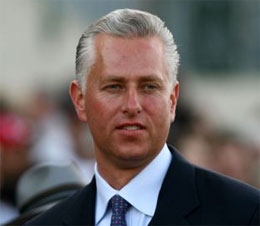
By Greg Thompson, Stallionesearch.com
DALLAS, TX—APRIL 28, 2014—During the week leading up to the Kentucky Derby, it is always a unique experience for me to find the connections to the Quarter Horse racing world in the storylines of the horsemen or horses contesting the 1 mile and ¼ event on the first Saturday in May. With this years favorite being trained up to the Derby at Los Alamitos, the connections to the Quarter Horse industry is significant enough.
Over the years I have been afforded the opportunity to reminisce with some of the great achievers in our sport of Quarter Horse racing, and I feel that it is absolutely one of the best perks of working for Stallionesearch.com. Whether it is getting on the phone to talk with Hall of Fame jockey Jerry Burgess or stopping in with legendary horsemen Marvin Barnes; their stories of Quarter Horse racings yesteryear is what I feel I will never get enough of.
On several occasions, Burgess has made reference to a young man he knew that use to assist his father on the backside of some of the racetracks throughout the southwest (most of the references do center around Ruidoso).
This young man he was alluding to has gone on to achieve more success in the sport of horse racing than anyone could have ever imagined. The young man in question used to spend the summers mucking stalls, and helping out with his father’s Quarter Horse / Thoroughbred racing stable on the backside of various racetracks. The young man Burgess is making references to would develop into the multi-Eclipse Award winning, and one-time Kentucky winning trainer Todd Pletcher. This coming Saturday, Pletcher will saddle four starters in the Kentucky Derby; the Thoroughbred world version of the All American Futurity.
Todd’s father, Jake Pletcher, was once a prominent trainer throughout the southwest, according to most sources. Todd began working with his father as a hot walker at the age of 7 at Ruidoso Downs in New Mexico. During his summers off from junior high and high school, Todd would continue to work with his father as a groom at tracks such as Louisiana Downs in Bossier City, Louisiana and Ak-Sar-Ben Racetrack in Omaha, Nebraska. He would also go out to California in his high school years to work for trainer Henry Moreno at Hollywood Park and Del Mar.
Todd began college at the University of Arizona Race Track Industry Program in the fall of 1985, and would go onto graduate with a Bachelors of Animal Science in 1989. It was in his college years that Todd would begin working with Hall of Fame Quarter Horse and Thoroughbred trainer D. Wayne Lukas. Todd would eventually become a top assistant for Lukas, splitting time in Florida and New York. Todd would serve as an assistant to Lukas until taking out his trainer’s license in December of 1995.
Since then, Todd has led the nation multiple times by money earned, won multiple trainer titles at various racetracks, trained multiple Eclipse award winners, and won the Eclipse award for champion trainer 6 times. He has trained earners of over $266 Million, including: the 2010 Kentucky winner Super Saver, 2007 Belmont Stakes winner Rags To Riches, 2013 Belmont winner Palace Malice. Todd was born in Dallas, Texas and graduated from James Madison High School in San Antonio, TX.
This past week as he prepares for the Kentucky Derby with his projected for entrants, Todd took a moment to discuss his Quarter Horse racing roots with Stallionesearch.com.
Stallionesearch: How did your father come to train racing Quarter Horses in the southwest?
Pletcher: I have an uncle on my mothers side of the family who was a Quarter Horse trainer, and so my father went to work with him. And then my father moved on to work for A.O. Phillips, who was the brother of prominent horsemen B.F. Phillips. He also worked for trainer Bubba Cascio at one time before branching out on his own. That is kind of a rough overview of how he got started in the business of training Quarter Horses.
Stallionesearch: What was it like spending the summers on the backside of Ruidoso Downs in your youth and tell us about some of your fondest memories?
Pletcher: I can recall quite of few of the summers there in Ruidoso, but the one summers that really stands out in my mind is the summer of 1975. That is the summer that my father had Chick’s Deck, and he went on to win the Kansas Futurity that year. He outrun Bugs Alive in 75 in the Kansas, and I think Chick’s Deck was third in the Rainbow Futurity that year behind Chick Called Sue.
This past summer my father gave me a book on Walter Merrick, and I was telling him before he handed me the book that I have a very vivid recollection of standing along the rail when Easy Date won the All American in 1974. She was in the outside post, and I can remember the field coming down the stretch and that she was so close the outside rail that I felt like I could almost reach out and touch her.
In my time at Ruidoso, I was able to witness two or three All American’s. We never missed watching it on television as a child when it was televised. But with it being run on Labor Day weekend, my mom and I would usually be moving back to El Paso around that time as the school year would have been on the verge of starting or may have already started. So I didn’t get to see as many All American Futurities growing up as I probably would have liked.
Stallionesearch: Some trainers have worked their whole life in the Quarter Horse racing world and have never gotten close to qualifying a horse to the All American Futurity. After winning the first leg of the Triple Crown in the Kansas Futurity, then placing in the Rainbow Futurity, your father’s trainee Chick’s Deck qualified into the field of the 1975 All American Futurity. Can you tell us what you recall about the emotion or the excitement when you found out he made the field for the All American?
Pletcher: To be honest with you, it isn’t the best of memories. We didn’t get to enjoy the moment for too long. Chick’s Deck didn’t come back well at all after the race, and it was obvious that he had sustained a knee injury in the trial. It was one of those occasions that we found out very shortly that he wasn’t going to be able to make it back to the finals even before they ran the last trial that day. We knew that he had made the field, but we also knew that he wouldn’t be running. So I remember the disappointment of that occasion more than the excitement of him qualifying for the All American.
Stallionesearch: You are one of the many top trainers in the thoroughbred world that once served as an assistant trainer to Hall of Famer Quarter Horse and Thoroughbred trainer D.Wayne Lukas. Was it is your connection to the Quarter Horse world through your father that landed you the opportunity to get on with Lukas?
Pletcher: My dad’s friendship with Wayne through his Quarter Horse training days was certainly what got my foot in the door to work for Lukas. I first worked for Wayne the summer between my sophomore and junior year of my time at the University of Arizona. I groomed horses for him in Chicago that summer. After that I just made an effort to stay in touch with him, and I flew out to California to interview for the foreman position with him, and it worked out well for me.
Stallionesearch: During your time with Lukas, and seeing that you both had a Quarter Horse racing background, was there much reminiscing or discussing Quarter Horse racing between the two of you?
Pletcher: Yes there was from time to time. Most of it centered around horses that he had trained, and me asking questions about them. We had some discussion about horses like Dash For Cash, and other famous horses that he had trained in his days in the Quarter Horse ranks. It was always fun to listen to his stories about those horses, and to have the opportunity to pick his brain about them.
Stallionesearch: In Quarter Horse racing, so much emphasis is put on the start of the race, and trainers spent a lot of time and effort standing horses in the starting gates, as well as what would be termed as “gate work”. Are there things learned from your time working with your father in the Quarter Horse ranks that you use in training your Thoroughbreds today?
Pletcher: Whether you are talking about a Quarter Horse or a Thoroughbred, the start is very important. Every race begins at the gate, and therefore these horses need to be prepared to break well. It doesn’t necessarily mean that you have to break as quickly with a Thoroughbred as you do with a Quarter Horse, but in both instances you don’t want to be handed a disadvantage right from the start of the race. The one thing I have learned over the years, and some of this probably could have been from my Quarter Horse background, is that you want your horses prepared to start by being relaxed in the gate as opposed to be fired up and antsy. I prefer the relaxed horse ready to break from the gates over the horse that is all coiled and too charged up.
Stallionesearch: You run a large, and highly successful Thoroughbred racing stable. Those in the racing industry realize that is a 365 days a year position, that is seemingly 24 hours a day, seven days a week. And with that type of schedule, do you ever get the chance to take a glance at what is happening in the Quarter Horse racing world?
Pletcher: I don’t get too much time for that sort of thing with how extensively we are involved in Thoroughbred racing. But from time to time I will watch the replay show from Los Alamitos when it is on, and I try to follow the All American Futurity on Labor Day when time allows.
Stallionesearch: You run horses at Sunland Park in the bigger stakes events. Have you had the opportunity to make the trip to see Ruidoso since your days of working with your father on the backside at Ruidoso Downs?
Pletcher: I would love to see that part of the country again. I grew up in El Paso, and I went to Elementary school there. I have run a few horses in the Sunland Derby at Sunland Park, and I have always wanted to have the chance to get back there to see New Mexico. That time of the year always coincides with the Ocala Two-Year Olds In-Training Sale in Florida, and therefore I can’t seem to make that trip. The Sunland Park area was always more home to me as compared to Ruidoso, because that is where I spent most of the time as a kid going to school. But I do have some great memories of Ruidoso, and I would love to get back to see it. I am horse racing fan whether it is Thoroughbred or Quarter Horse, and hopefully one day I can get back there to see an All American one day. I think that would be some great fun.
|
||
 Newsletters
 Facebook
Copyright © 2026 StallioneSearch, LLC, All rights reserved internationally.